Discover the key differences between assisted living and long‑term care. Learn how DosePacker's smart solutions support dignified care.

Here’s a reality check: family caregiving is a national concern. According to AARP’s 2026 report, roughly 59 million family caregivers provided 49.5 billion hours of unpaid care in 2024, valued at an estimated $1.01 trillion annually. Behind that number are millions of families balancing work, emotional strain, and financial pressure while caring for aging parents.
With so much at stake, understanding assisted living vs. long-term care can clarify an otherwise overwhelming decision.
Think about your loved one’s day-to-day life. Are they mostly independent but need help with certain activities? Or do they require more extensive supervision and ongoing medical support?
Let’s look at what each setting offers, how they differ, and how medication management can support safer, more efficient care in both.
Looking for a Smarter Approach to Senior Care?
If you're wondering what is assisted living, it is a residential care option for older adults who are mostly independent but need some support with everyday activities.
These communities suit people who may no longer feel comfortable or safe living entirely on their own but do not require the level of medical care typically provided in a nursing facility.
Residents generally live in private or semi-private apartments with access to dining, recreational activities, wellness programs, transportation, and shared community spaces.
Staff may assist with activities such as:
The goal is to provide support without taking away a resident’s independence. Residents can maintain their routines and social connections while having help available when they need it.
Medication support can also become an important part of daily care. For communities managing complex medication routines, structured medication management for assisted living can help make doses easier to organize, administer, and track.
The environment is typically residential and socially oriented, with activities, group outings, dining areas, gardens, and other opportunities for connection. Assisted living is not simply about meeting physical needs; it is about creating an environment where older adults can remain engaged while receiving the support they need.
If you're asking what is long-term care, it refers to ongoing assistance for people who need substantial support with daily activities, supervision, or complex medical and nursing needs.
Long-term care may be provided in nursing homes and other residential settings, depending on an individual’s needs. Residents may require this level of care because of chronic illness, disability, significant physical limitations, or advanced cognitive impairment.
Care may include:
Unlike a typical assisted living environment, long-term care can involve more intensive clinical oversight. Licensed nurses and other healthcare professionals may be involved in coordinating care, monitoring health conditions, and managing complex treatment plans.
Many facilities also work with a long-term care pharmacy to coordinate prescriptions, dispensing, packaging, and medication-related services for residents with complex medication regimens.
The goal is comprehensive support and safety for individuals who can no longer manage their health or daily activities safely with limited assistance.
Let's compare assisted living and long-term care facilities by level of care, cost, and other key factors.
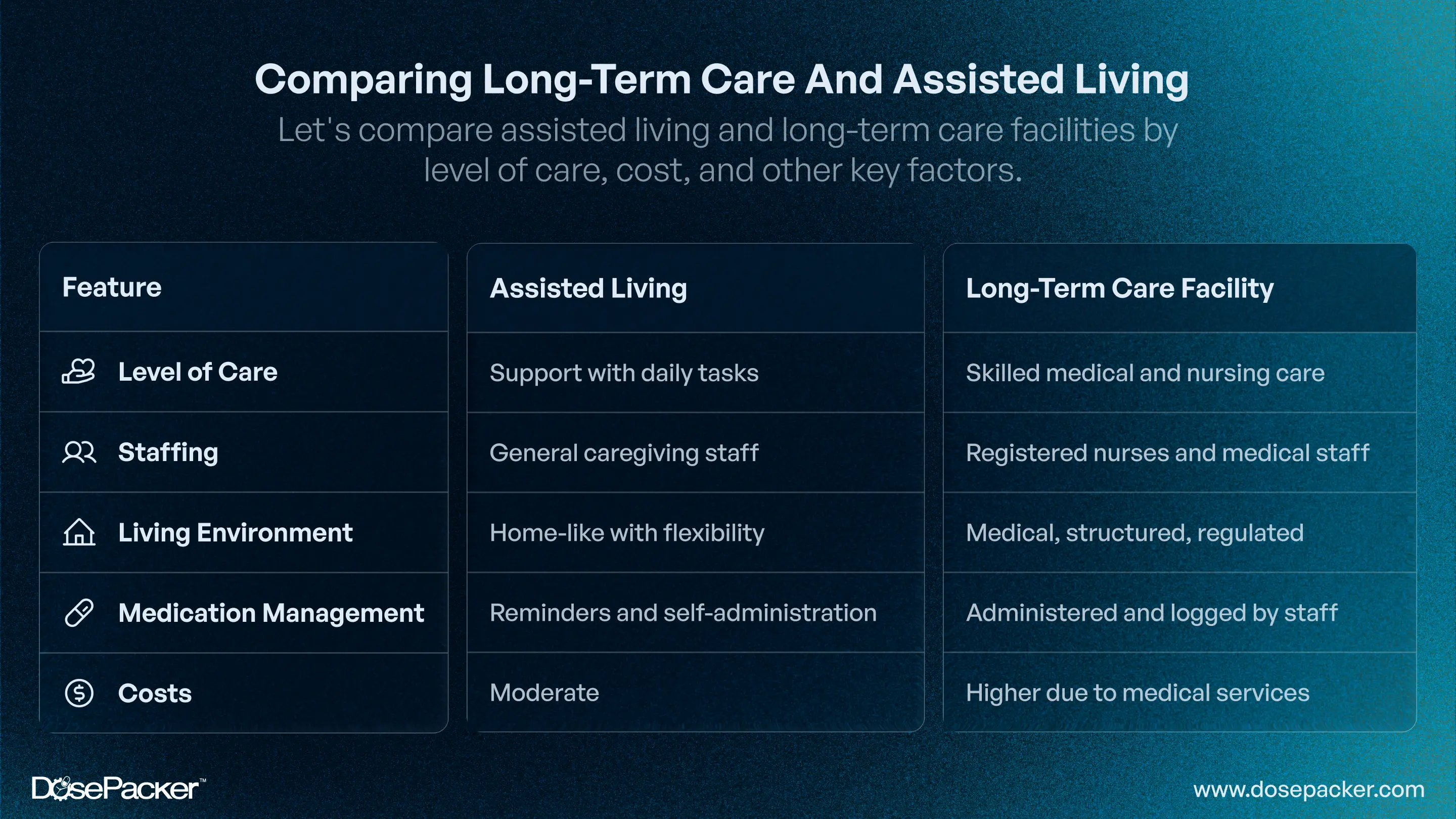
When considering long-term care vs assisted living, the key question is not which option is better overall, but which level of support matches your loved one's current needs.
The difference between long-term care and assisted living is primarily the intensity of support and medical oversight involved. Assisted living generally emphasizes independence with assistance, while long-term care is designed for people who require more extensive ongoing support.
The difference between assisted living and long-term care can also change as a person's health, mobility, cognition, or ability to manage daily activities changes. That is why families should consider both current needs and how those needs may evolve.
Families may also encounter other care options during their research. Someone who needs little hands-on support may be comparing assisted living with independent living, while someone experiencing significant cognitive changes may need to understand the differences between assisted living vs memory care. For individuals requiring more intensive clinical support, understanding assisted living vs skilled nursing facility care can also help clarify which setting may be appropriate.
One important consideration in the assisted living vs. long-term care decision is that care needs can change.
An older adult may enter assisted living while remaining relatively independent and later require additional support because of changes in mobility, cognition, chronic conditions, or medication needs.
That does not necessarily mean families should automatically choose the most intensive care setting from the beginning. Instead, it is important to understand how flexible the community is and what happens if needs increase.
Before choosing a setting, ask:
Thinking ahead can help families choose an environment that is appropriate now while considering what may be needed later.
Medication management is critical across long-term care and assisted living, but the approach and level of support can differ.
In assisted living, staff may provide reminders, assistance, or medication administration depending on the resident’s needs and the community’s policies. Multiple prescriptions, different administration times, medication changes, and cognitive challenges can make these routines difficult to coordinate.
Manual tracking, handwritten documentation, and unclear medication schedules can add unnecessary complexity and increase the possibility of missed or incorrect doses.
Long-term care facilities generally have more structured medication administration processes because residents often have more complex health and medication needs. Nurses and other authorized staff must coordinate medication schedules while also managing other aspects of resident care.
Even with established protocols, busy workflows can create challenges.
In fact, medication management is an important consideration when evaluating assisted living vs. long-term care, because the level of medication support may change significantly depending on a resident’s needs.
Medication management should support caregivers, not create more work for them.
DosePacker provides pre-sorted, time-stamped, multi-dose compliance packaging that organizes medications by date and time of administration. Each dose is clearly labeled, helping caregivers quickly identify what to administer and when.
The packs can also be scanned for automated documentation, helping care teams maintain clearer records and improve visibility into medication administration.
For communities that already use assisted living software, DosePacker can complement existing workflows by providing a more organized approach to medication packaging, administration, and tracking.
Real-time visibility can also help care teams and families stay informed about medication schedules and potential delays or missed doses.
For organizations evaluating medication management solutions for assisted living, the goal should be more than simply organizing medications. Medication management for senior living community settings should support clear workflows, reliable documentation, and greater visibility while reducing unnecessary manual steps.
Choosing between care settings is about more than comparing services on paper. When weighing long-term care vs assisted living, families should consider how well each option can meet their loved one’s needs today and adapt as those needs change.
The right questions can help you look beyond the facility itself and determine whether its level of care, services, and approach are a good fit for your loved one.
Choosing between long-term care and assisted living is ultimately about understanding what your loved one needs today and what support they may need tomorrow. Assisted living can provide the right balance of independence and assistance for some older adults, while long-term care offers more comprehensive support when medical or daily care needs become more complex.
Whatever setting you choose, reliable support systems can make a meaningful difference. Medication management is one area where the right tools can help caregivers reduce manual work, improve consistency, and keep daily routines organized.
DosePacker helps senior care communities simplify medication management with pre-sorted compliance packaging and tools designed to support clearer, more efficient medication workflows.
Because better systems do more than organize medications, they give caregivers more time to focus on the people who depend on them.
Is Your Loved One Getting the Right Level of Care?
Explore the care options that fit their needs.