Understand the key differences between assisted living and memory care to know which is better suited for your loved one’s unique care needs.

When your loved one starts drifting from routine moments, forgetting appointments, getting lost on familiar routes, it can feel like pieces of their life are quietly slipping away. You may find yourself asking, “What is assisted living?” and “What is the difference between assisted living and memory care?”, wondering which option will best honor their dignity, safety, and everyday needs.
Recent studies reveal that nearly 60% of residents in assisted living facilities move to a memory care or skilled nursing facility within two years, a decision not to be taken lightly, yet one that is common among families navigating changing care needs.
In this guide, we’ll break down the differences between assisted living and memory care facility environments, clarify who each is intended for, and explore how care technology, such as that offered by DosePacker, plays a role in supporting both.
Assisted living is ideal for older adults who are mostly independent but require assistance with day-to-day tasks, such as bathing, dressing, medication management, or housekeeping. These communities strike a balance between freedom and support, offering:
In short, assisted living is designed for individuals who require some assistance but do not require full-time medical supervision.
Memory care, on the other hand, is a specialized type of long-term care focused on residents with Alzheimer’s disease, dementia, or other cognitive conditions. These communities are built for safety, comfort, and familiarity.
Key features include:
So, memory care versus assisted living isn’t just about having more staff; it’s about a completely tailored approach to cognitive challenges.
It’s natural for families to delay moving a loved one to memory care. After all, assisted living can support residents with early-stage dementia. But as cognitive decline progresses, the risks grow.
Ask yourself:
These are signs it might be time to explore memory care options. In contrast, if your loved one simply needs physical help but their memory is still sharp, assisted living might still be the better fit.
One of the most defining differences between assisted living and memory care facility settings is the level of staff training.
Memory care teams receive specialized instruction in dementia behavior management, redirection techniques, and non-verbal communication.
In assisted living, staff may not have the same depth of training, though they provide compassionate support for physical needs.
The environments also differ: memory care units are often smaller and feature secured entrances, motion sensors, and clear, guided hallways. Assisted living offers safety, too, with features such as handrails, emergency buttons, and well-lit corridors, but people come and go more freely.
Reflect on your loved one’s daily risk: if safe independence is possible, assisted living may be ideal. If needs lean toward constant support, memory care provides peace of mind.
One of the most significant distinctions between memory care and assisted living is how medication is managed. In assisted living, caregivers offer gentle reminders and provide assistance with self-administration. In memory care, management is more active – medication is tracked, administered, and logged daily, with secure storage and regular oversight.
Mistakes in med-pass processes are surprisingly common and can be dangerous. That’s why tools like DosePacker’s medication management solutions support both environments by automating med-packs, time-stamping dosage, and syncing to digital records, reducing errors and freeing space for compassion.
By simplifying the process, caregivers can spend more time with residents, and families can feel more confident about the care being delivered.
Memory care typically costs more, reflecting the need for round-the-clock supervision and specialized programming. Assisted living is often more cost-effective initially, but may require transitions as needs evolve.
When comparing assisted living vs memory care facility costs, consider:
Planning early helps families feel financially and emotionally prepared.
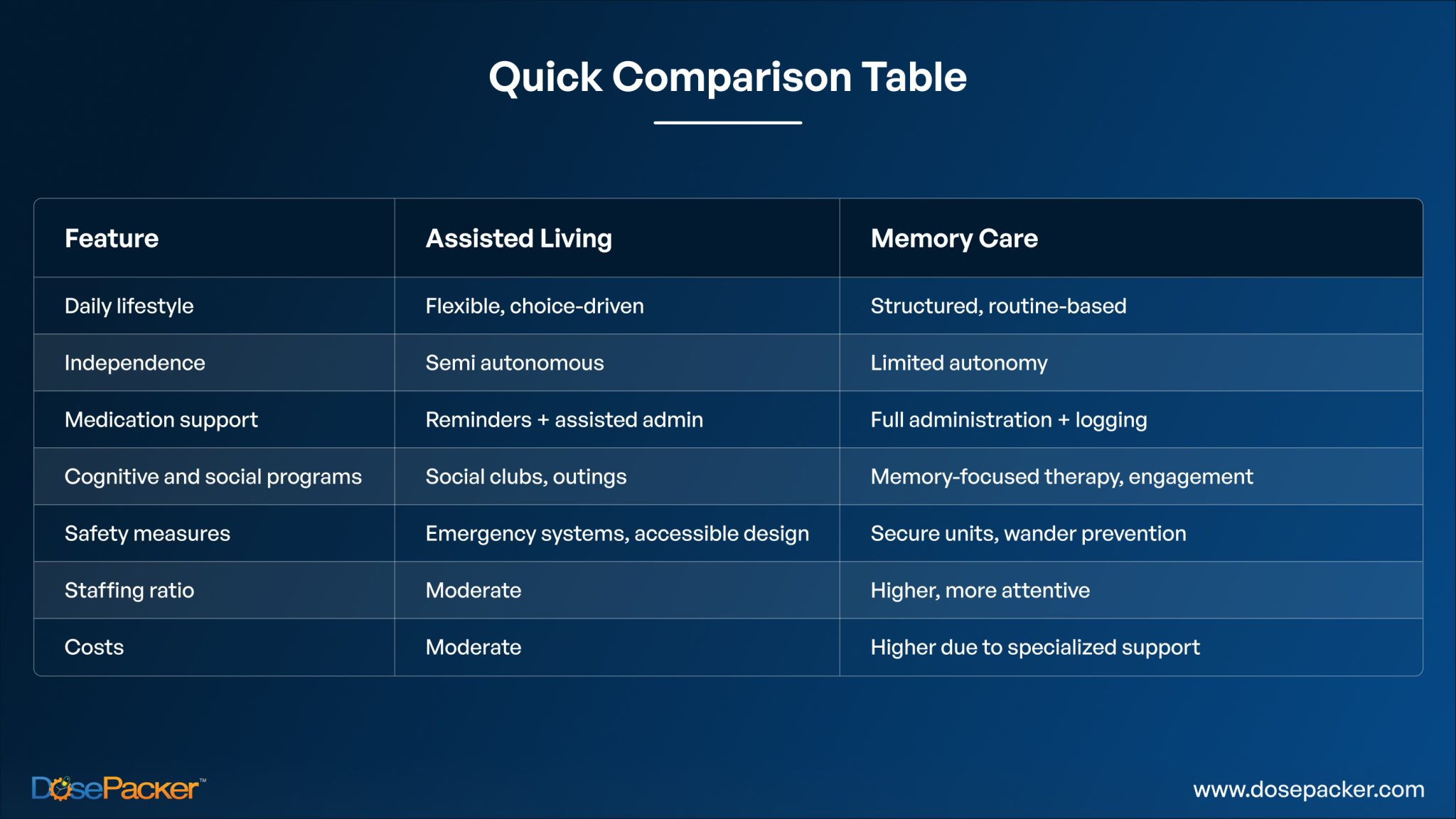
Here’s a quick look:
Factors | Assisted Living | Memory Care |
|---|---|---|
Avg. Monthly Cost (US) | ||
Staff Training | General caregiving support | Dementia specific training |
Environment | Home-like, less structured | Secured, predictable, cognitively safe |
Medication Management | Scheduled reminders | Supervised with strict adherence |
Ideal For | Seniors needing help with daily tasks | Seniors with Alzheimer’s/dementia |
Discover the key differences between Assisted Living and Skilled Nursing Facilities in our blog post on Assisted Living vs Skilled Nursing Facilities.
Assisted living encourages diverse social engagement through activities such as book clubs, fitness classes, and casual gatherings, keeping life vibrant.
Memory care focuses on emotional enrichment, structured activities, music and art therapy, and sensory garden time, all tailored to residents’ cognitive abilities. This helps reduce anxiety and improve mood in meaningful ways.
Sometimes, a resident in assisted living may need to transition to a memory care facility. This shift doesn’t have to be sudden or traumatic. The key is to observe changes early, particularly in behavior, confusion, and safety awareness.
Facilities that offer both care levels under one roof (also known as continuum of care campuses) can make this transition much smoother, with familiar surroundings and staff.
Choosing between assisted living and memory care is a big decision, and touring facilities can be overwhelming. Asking the right questions helps you see beyond brochures and truly understand how a community operates on a daily basis. It ensures that your loved one will receive not just adequate support, but care that’s thoughtful, safe, and aligned with their evolving needs.
Here are some essential questions to ask when evaluating a facility:
These questions help clarify real concerns and enable you to make an informed decision.
The decision between assisted living vs memory care is never black and white. It’s deeply personal and often emotional. What matters most is understanding the unique needs of your loved one, being honest about what support they need today, and staying prepared for what tomorrow might bring.
Assisted living fosters independence with gentle support. Memory care provides protection, structure, and cognitive-specific care. With smart tools like those from DosePacker, both environments can enhance medication safety, provide peace of mind, and support improved outcomes.
Families who choose thoughtfully often find environments that not only meet needs but also enrich later life. With planning and purpose, assisted living can be a home, and memory care can be a place to thrive!
So, whether you’re planning ahead or making decisions in the moment, know that you’re not alone. With the right resources, you can find a place where your loved one continues to live well, fully supported, and deeply respected.
To see how DosePacker elevates care facilities with smart solutions, contact us today!