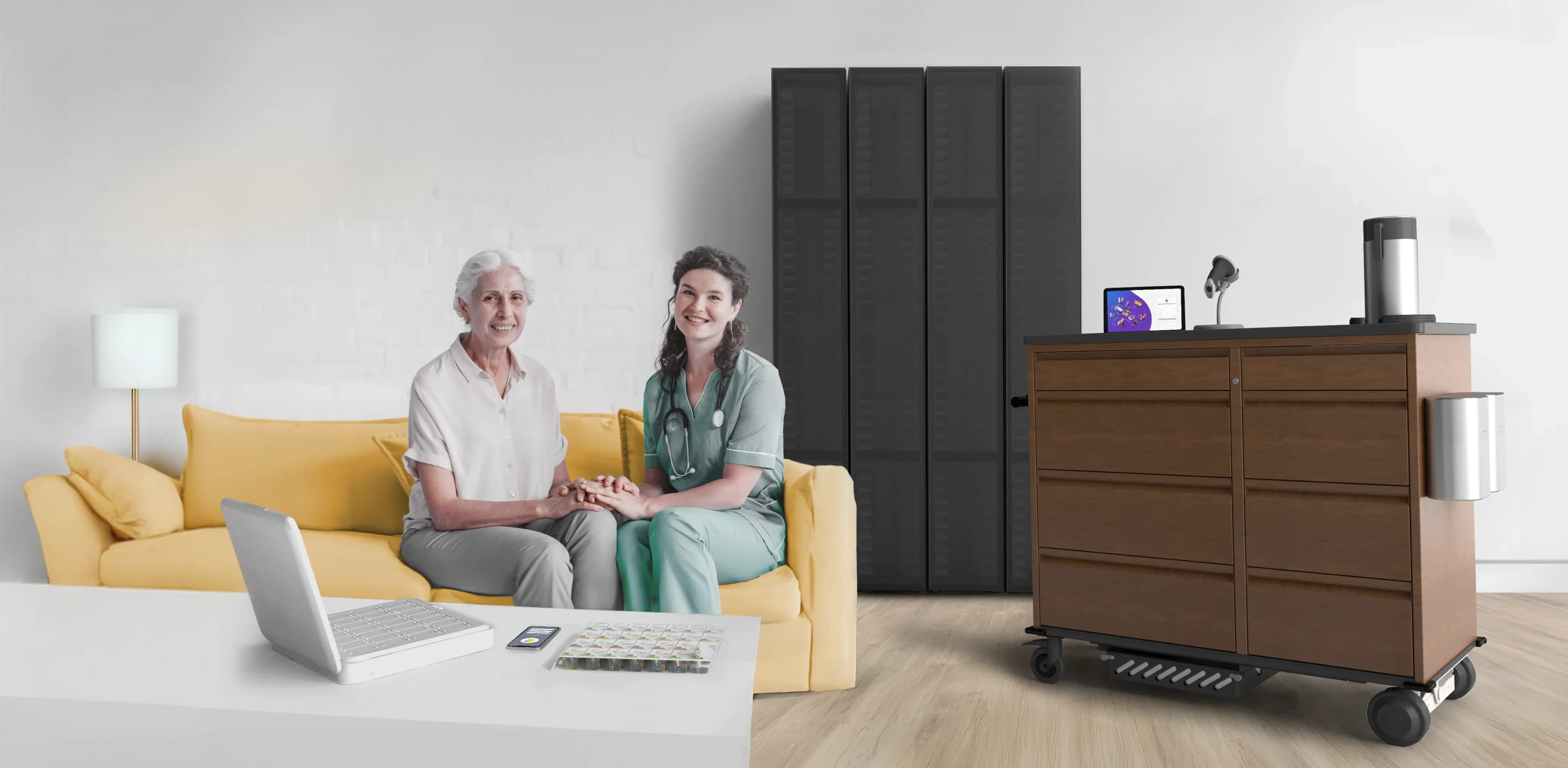
Learn the essential factors for choosing the right medical cart that enhances workflow efficiency and medication safety. This comprehensive guide covers ergonomics, durability, storage solutions, and how innovative carts like DoseKart are transforming medication management in healthcare facilities.
Picture this: It’s 6 AM at Riverside Care Center. Nurse Sarah begins her medication rounds, pushing a cart that wobbles with every step. The squeaky wheel announces her arrival to sleeping patients. Halfway down the corridor, a drawer flies open, and medication packets scatter across the floor. Sound familiar?
The medical cart you choose isn’t just furniture; it’s the workhorse of your medication delivery system. A poor choice leads to inefficiency, staff frustration, and potential safety risks. The right cart? It transforms your entire med pass routine.
Discover how DoseKart is making med pass easier for facilities just like yours.
With thousands of med carts on the market, from basic utility models to sophisticated medication carts with electronic locks, how do you identify the best fit? Let’s break down exactly what matters.
A medication cart is more than just a storage solution; it’s the mobile command center for medication administration. According to the Institute of Medicine, medication errors affect at least 1.5 million people annually in the United States. with distribution errors being a significant contributor. Your cart plays a direct role in preventing these errors.
Think of your medical cart as your caregiver’s partner on every shift. Would you hire a partner who’s unreliable, difficult to work with, and creates more problems than they solve? Probably not. The same logic applies here.
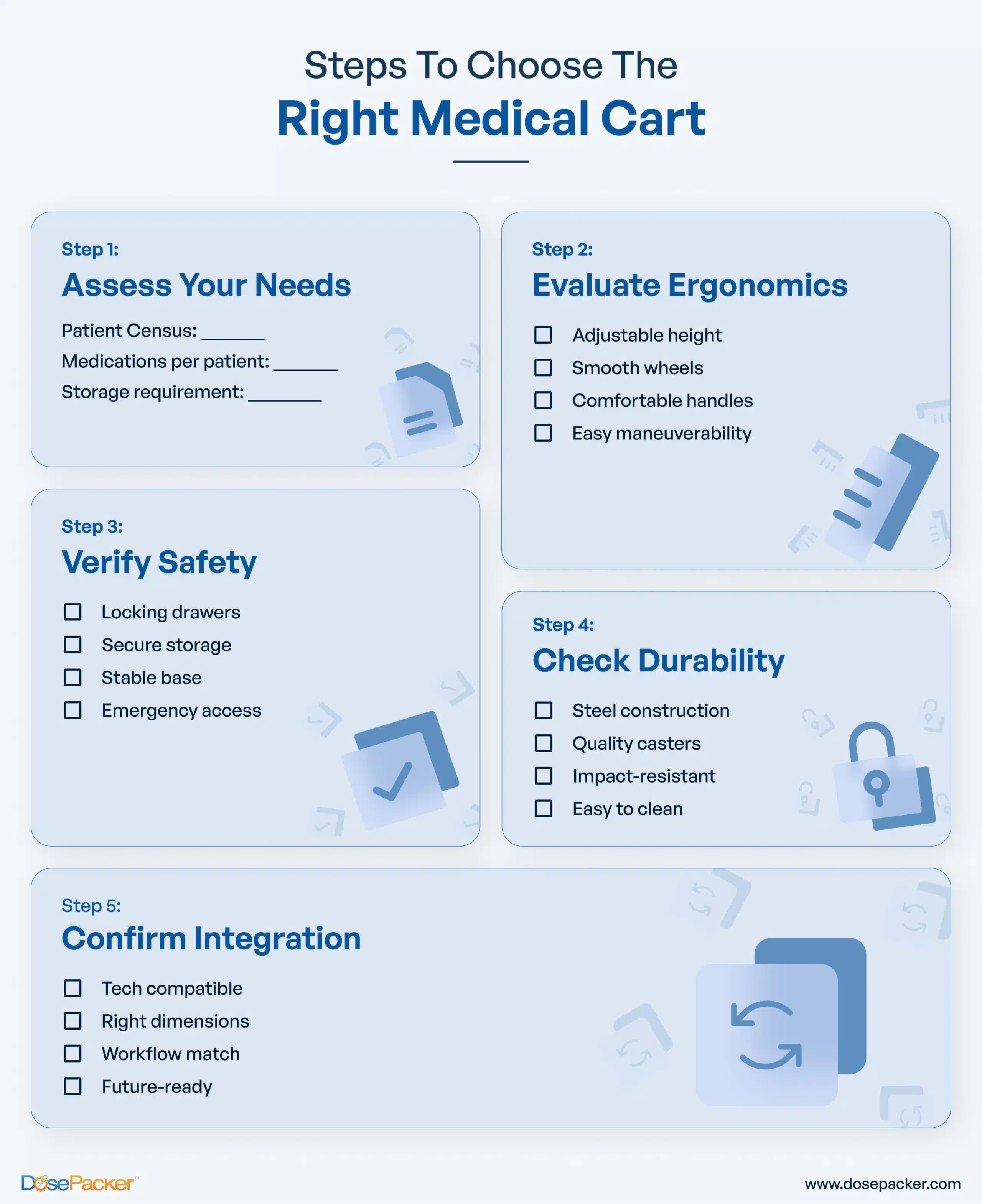
Making an informed decision always includes checklists, and here we’ve compiled a quick list of factors that should be non-negotiable when selecting a medication cart for your care community.
Healthcare workers already face enormous physical demands. The Bureau of Labor Statistics reports that nursing assistants and nurses experience some of the highest rates of musculoskeletal disorders among all occupations. Your cart shouldn’t add to this burden.
What to look for:
Consider this: If a nurse pushes a cart 50 times per day over rough surfaces, that’s 250 pushes per workweek. Over a year? That’s 13,000 repetitive motions. Small ergonomic improvements multiply exponentially.
Medication security isn’t optional; it’s mandated by federal regulations and accreditation standards. The DEA requires controlled substances to be “securely locked” at all times when not in use.
Essential safety features include:
Med cart safety goes beyond locks. Proper medication cart organization plays an equally crucial role in preventing administration errors.
Here’s where many facilities stumble. They either overestimate (buying expensive, oversized carts) or underestimate (cramming medications dangerously).
Calculate your actual needs:
A 30-bed assisted living facility using multi-dose packaging will have vastly different storage needs than a 100-bed skilled nursing facility using traditional pharmacy bottles.
Pro tip: If you’re using multi-dose packaging systems, look for carts specifically designed with appropriately-sized compartments. Traditional med carts often waste space or force you to awkwardly stack packets.
A medical cart might seem like a simple purchase, but it’s actually a multi-year investment. Cheap carts replaced every two years cost more—and cause more disruptions—than quality carts lasting a decade.
Material considerations:
How do you test durability before buying? Ask for references from similar facilities. A hospice care’s “durable cart” might not survive the demands of a busy skilled nursing facility.
The best medication cart works with your systems, not against them. Does your facility use barcode medication administration? Electronic health records? Automated dispensing?
Integration questions to ask:
Technology integration is where DoseKart stands apart from traditional med carts. Purpose-built for modern medication delivery systems, it seamlessly accommodates multi-dose packaging while providing the organization and efficiency busy facilities demand.
Assisted Living Facilities: Focus on quieter operation (patients are home here) and simpler medication regimens. Carts with compartments for personal items alongside medications work well.
Skilled Nursing Facilities: Prioritize infection control with seamless, easy-to-disinfect surfaces. Larger storage capacity handles complex medication regimens and frequent turnovers.
Long-Term Care: Balance between capacity (high patient census) and maneuverability (navigate long corridors and shared spaces). Durability matters tremendously here with intensive daily use.
Don’t just read specs, engage with suppliers:
A reputable supplier welcomes these questions. Hesitation? That’s your red flag.
While we’ve discussed general medical cart selection, it’s worth noting that some carts are specifically engineered for particular medication delivery systems. DoseKart, for instance, was designed from the ground up for unit-dose and multi-dose packaging systems, addressing the exact frustrations that Nurse Sarah experienced in our opening story.
What makes purpose-built carts different? They eliminate the compromises inherent in “one-size-fits-all” solutions. Instead of adapting your workflow to the cart, the cart adapts to your workflow.
Choosing the best medical cart for your facility isn’t about finding the most expensive option or the one with the most features. It’s about identifying the cart that matches your specific needs, protects your staff, ensures medication safety, and delivers lasting value.
Start by auditing your current situation:
Armed with this information and the framework we’ve provided, you’re equipped to make a confident decision.
Ready to see how the right cart transforms your medication management? Explore DoseKart and discover why forward-thinking facilities are making the switch to purpose-built medication delivery solutions.