Effective drug formulary management requires more than maintaining a medication list. Learn the best practices that help long-term care pharmacies improve medication safety, streamline workflows, and support better resident outcomes.

A formulary may appear to be just a list of approved medications, but it influences nearly every aspect of pharmacy operations. Every medication added, removed, or restricted affects prescribing decisions, inventory planning, reimbursement, dispensing workflows, and ultimately, resident care. For long-term care pharmacies, where medication regimens are often complex and continuously evolving, managing a formulary effectively is just as important as building one.
The importance of a disciplined approach is reflected in global patient safety data. According to WHO, at least 1 in 20 patients worldwide experiences preventable medication-related harm, with nearly one-quarter of those incidents classified as severe or life-threatening. While not every medication-related event is linked to formulary decisions, structured drug formulary management plays an important role in promoting evidence-based prescribing, reducing medication risks, and supporting safer, more consistent care.
This is why best practices in formulary management matter. Strong drug formulary management is an ongoing process built on sound governance, clinical evidence, continuous review, and connected technology. In this guide, we'll explore the practices that help long-term care pharmacies improve medication safety.
Want to see how these best practices translate into everyday pharmacy workflows?
Every pharmacy maintains a formulary, but the most effective ones are managed through a consistent set of principles rather than isolated decisions. These principles create the foundation for medication choices that are clinically sound, operationally efficient, and responsive to changing healthcare needs.
Effective formulary decisions begin with clear ownership. A multidisciplinary pharmacy and therapeutics (P&T) committee brings together pharmacists, physicians, nursing leaders, and other clinical stakeholders to evaluate medications, establish policies, and ensure decisions remain consistent across the organization.
Every medication should be evaluated using current clinical evidence, therapeutic value, safety, and the needs of the resident population, not prescribing habits or cost alone. This helps ensure the formulary supports both quality care and long-term sustainability.
A formulary should evolve alongside clinical practice. Regular reviews of medication utilization, treatment guidelines, drug shortages, and new therapies help keep it relevant and effective, rather than allowing it to become outdated.
Even the best decisions lose value if they aren't reflected in day-to-day pharmacy operations. Integrated technology helps translate formulary updates into dispensing, inventory, packaging, and administration workflows while giving teams access to accurate, real-time information.
Together, these four principles form the foundation of effective drug formulary management. The best practices below show how leading long-term care pharmacies put them into action.
Every successful formulary begins with clear ownership. Without a structured governance process, medication decisions can become inconsistent, reactive, or influenced by individual preferences rather than clinical evidence. Establishing a formal decision-making framework helps ensure that every formulary update adheres to consistent objective criteria and supports the organization's broader clinical and operational goals.
Most healthcare organizations rely on a multidisciplinary pharmacy and therapeutics (P&T) committee to oversee drug formulary management. These committees typically include pharmacists, physicians, nursing leaders, and other clinical stakeholders who bring diverse perspectives to medication evaluation. By combining clinical expertise with operational insight, they can make balanced decisions that prioritize patient safety while considering workflow, reimbursement, and resource utilization.
Strong governance also requires clearly defined responsibilities. Committee members should understand who is responsible for reviewing new medications, monitoring formulary performance, approving changes, and communicating updates across the organization. Establishing a regular review cadence rather than meeting only when issues arise helps ensure the formulary remains aligned with evolving clinical evidence, treatment guidelines, and organizational priorities.
Ultimately, governance provides the structure that keeps formulary decisions consistent, transparent, and defensible. When all medications are evaluated using the same process, pharmacies can reduce unnecessary variation, improve prescribing consistency, and build greater confidence among clinicians, administrators, and care teams.
Cost will always be an important consideration in pharmacy operations, but it should never be the starting point for formulary decisions. Effective drug formulary management begins with evaluating whether a medication is clinically appropriate, safe, and capable of delivering meaningful therapeutic value for the resident population. Only after those factors have been assessed should financial considerations such as acquisition costs, reimbursement, and contracting agreements come into play.
A structured clinical review helps ensure that medications are selected based on consistent, evidence-based criteria rather than individual prescribing preferences or short-term cost savings. Pharmacy and Therapeutics (P&T) committees typically assess a medication's efficacy, safety profile, place in therapy, comparative effectiveness, and alignment with current clinical guidelines before recommending its inclusion or restriction within the formulary.
Taking this approach also supports greater transparency and consistency. When all medications are evaluated against the same clinical standards, formulary decisions become easier to justify to prescribers, administrators, and regulatory bodies. It also reduces unnecessary variation in prescribing practices and helps maintain confidence in the formulary as a trusted clinical resource.
Making the right decision is important, but documenting why that decision was made is equally valuable. Recording the clinical evidence reviewed, therapeutic alternatives considered, and the reasoning behind each approval, restriction, or removal creates a reliable reference for future committee discussions.
Well-documented decisions also simplify formulary reviews, support audits, and make it easier to evaluate exception requests when resident-specific clinical needs arise. As new evidence and therapies emerge, this documentation provides the context needed to revisit previous decisions without having to start the evaluation process from scratch.
No single formulary structure works for every healthcare organization. The right approach depends on factors such as resident complexity, prescribing patterns, payer requirements, and operational goals. One of the most important decisions pharmacies make is determining how much prescribing flexibility to allow while maintaining consistency and cost control.
Many organizations adopt an open and closed formulary approach based on their clinical and operational needs. An open formulary provides prescribers with greater flexibility by allowing access to a broader range of medications, making it well suited for populations with diverse or highly individualized treatment requirements. A closed formulary, on the other hand, limits medication choices to a defined list of approved therapies, helping standardize prescribing, simplify inventory management, and improve cost predictability.
For long-term care pharmacies, the ideal strategy often falls somewhere between these two models. Standardizing medications where appropriate improves operational efficiency, but there should also be room for clinically justified exceptions when a resident's needs require an alternative therapy.
Rather than viewing formulary design as a one-time decision, successful pharmacies periodically reassess whether their current structure continues to support resident outcomes, regulatory requirements, and evolving clinical practice.
A formulary should never be treated as a static document. New medications receive approval, treatment guidelines evolve, drug shortages disrupt availability, and prescribing patterns change throughout the year. Without regular review, even a well-designed formulary can quickly become outdated.
Leading pharmacies approach drug formulary management as an ongoing process rather than an annual committee exercise. Scheduled reviews help evaluate medication utilization, identify therapeutic duplication, assess new clinical evidence, and determine whether existing formulary decisions continue to meet the needs of the resident population.
Continuous monitoring also enables organizations to respond more proactively to market changes. Whether addressing a medication shortage, evaluating a newly approved therapy, or reviewing unexpected increases in utilization, timely updates help minimize disruption to pharmacy workflows while maintaining consistency in patient care.
Just as importantly, regular reviews create opportunities for continuous improvement. By analyzing prescribing trends and clinical outcomes over time, pharmacies can refine their formulary strategy, strengthen medication safety, and ensure that decisions remain aligned with current standards of care.
No formulary can account for every clinical scenario. Residents may have unique therapeutic needs, medication intolerances, or treatment histories that require therapies outside the approved drug list. That's why effective drug formulary management extends beyond selecting medications; it also includes a clear process for handling exceptions.
An efficient exception pathway ensures clinically appropriate requests are reviewed quickly without creating unnecessary delays in treatment. Establishing standardized criteria, assigning clear ownership, and defining expected turnaround times helps pharmacies respond consistently while maintaining the integrity of the formulary.
Just as importantly, exception requests should be viewed as valuable data rather than isolated events. If the same medications or therapeutic classes repeatedly require exceptions, it may indicate that the formulary no longer reflects current clinical practice or resident needs. Regularly reviewing these trends helps organizations refine their formulary and make more informed decisions during future evaluations.
By treating exceptions as opportunities for improvement instead of disruptions, pharmacies can maintain both clinical flexibility and operational consistency.
As formularies become more dynamic, managing them through spreadsheets, emails, or disconnected systems becomes increasingly difficult. Without a centralized source of truth, updates can be delayed, facilities may work from outdated information, and pharmacy teams spend valuable time reconciling data across multiple platforms.
Modern pharmacy formulary management solutions help address these challenges by centralizing medication information, providing real-time visibility into utilization trends, and ensuring that formulary updates are consistently reflected across pharmacy operations. This not only improves decision-making but also reduces administrative burden and supports better coordination between prescribers, pharmacists, and care teams.
DosePacker extends these capabilities by integrating formulary-driven workflows into a comprehensive medication management ecosystem designed specifically for long-term care pharmacies. Instead of managing medication decisions in one system and dispensing or packaging in another, pharmacies can connect key workflows within a single platform.
With DosePacker, pharmacies can:
By connecting formulary decisions with day-to-day pharmacy operations, DosePacker helps long-term care pharmacies improve efficiency, support medication safety, and deliver more consistent resident care.
A formulary isn't successful simply because it's implemented; it needs to demonstrate measurable value over time. Monitoring performance helps pharmacies understand whether formulary decisions are improving medication safety, supporting clinical outcomes, and contributing to more efficient operations.
Rather than focusing solely on drug acquisition costs, leading organizations evaluate a broader range of performance indicators. These may include formulary adherence, medication utilization trends, therapeutic duplication, generic prescribing rates, inventory waste, turnaround times for exception requests, and prescribing variations across facilities. Together, these insights provide a more complete picture of how effectively the formulary is supporting pharmacy operations.
Performance measurement also creates a continuous feedback loop. Reviewing trends over time allows pharmacy leaders to identify opportunities for improvement, evaluate the impact of formulary changes, and respond proactively to evolving clinical, operational, and regulatory demands.
Ultimately, the most effective drug formulary management programs are those that continue to evolve. By combining structured governance, evidence-based decision-making, continuous monitoring, and integrated technology with ongoing performance evaluation, pharmacies can build formularies that remain relevant, resilient, and focused on delivering better resident care.
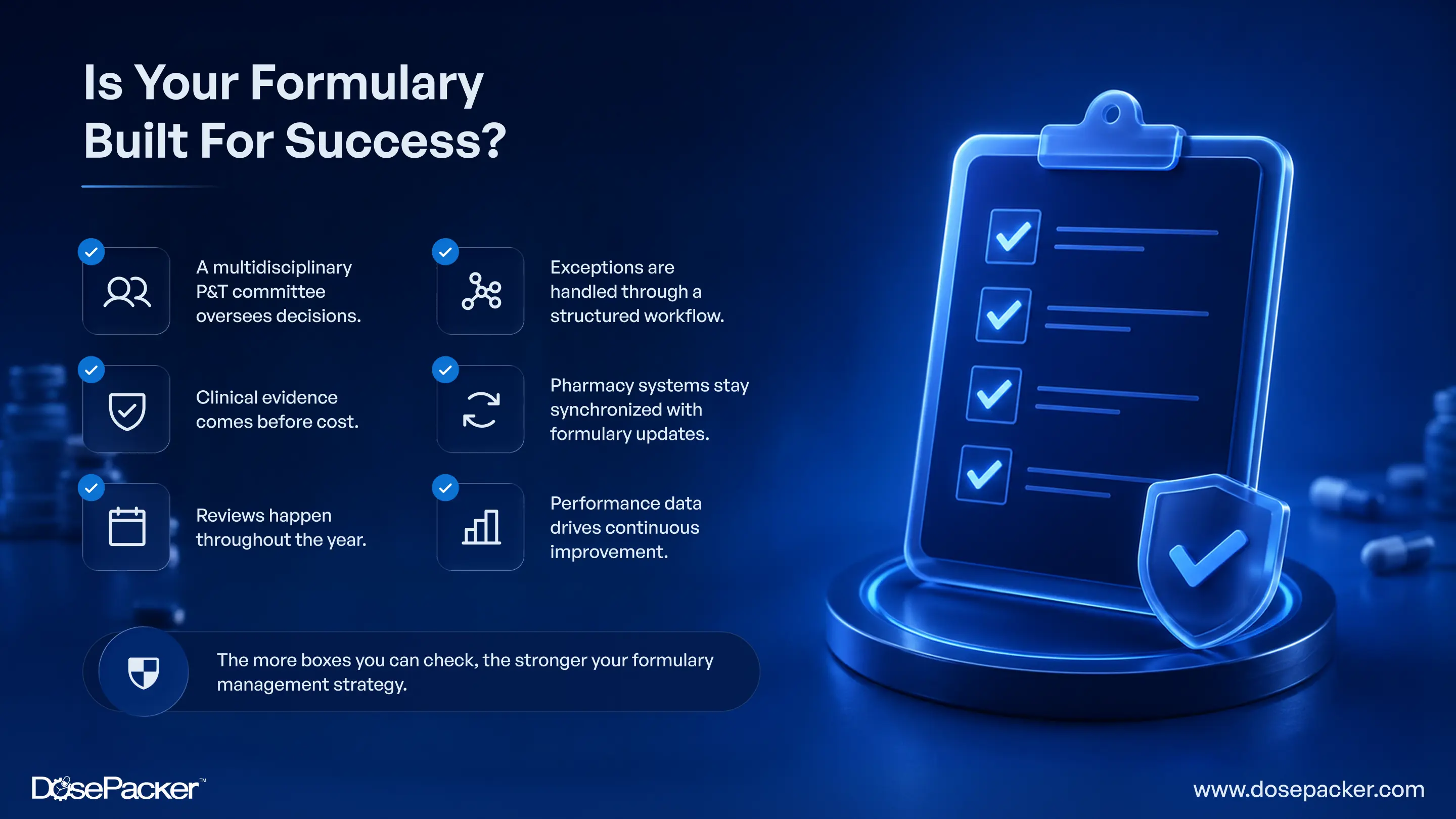
A formulary doesn't improve medication management simply because it exists. Its value lies in how consistently it's governed, reviewed, and put into practice. The strongest drug formulary management programs combine evidence-based decision-making with structured governance, continuous evaluation, efficient exception management, connected technology, and ongoing performance measurement to support safer, more consistent pharmacy operations.
For long-term care pharmacies, these best practices help address the unique challenges of managing complex medication regimens, evolving clinical guidelines, and multiple care settings. They also create a more proactive approach to medication management: one that reduces inefficiencies, strengthens prescribing consistency, and supports better outcomes for both pharmacy teams and the residents they serve.
As medication use continues to evolve, formulary management must evolve with it. By treating the formulary as a dynamic clinical and operational strategy rather than a static list of approved medications, pharmacies can build a stronger foundation for safer care, greater efficiency, and long-term success.
Ready to Put These Best Practices into Action?
Explore how DosePacker helps long-term care pharmacies streamline medication management, improve operational visibility, and support formulary-driven workflows.