Discover the true cost of medication errors, their impact on resident safety, and effective strategies for preventing medication errors in care facilities with DosePacker.
Medication error morbidity and mortality costs are estimated to run $77 billion per year. Therefore, patient safety is a major public health concern.
In fact, each year in the U.S., over 1.5 million medication errors occur in long-term care settings, most during med-passes, leading to adverse events, hospitalizations, and soaring costs for both residents and facilities. In addition to the physical harm, these mistakes carry a silent and often overlooked price tag. Discover more about medication errors in skilled nursing and assisted living by accessing deeper data.
Medication errors don’t just impact resident health; they drive up costs, strain staff, and damage a facility’s reputation. From emergency care to regulatory consequences, even a single mistake can have wide-reaching effects. Understanding these hidden costs is key to preventing them.
A single adverse medication event can result in emergency room visits, hospital stays, and even lawsuits costing thousands per incident. Administrative time spent on investigations, documentation, and re-training further strains budgets.
When staff are constantly scrambling to document errors or copy paperwork, burnout follows. Turnover rates rise, resulting in increased recruitment and onboarding costs, as well as declines in care consistency.
Word spreads fast; one high-profile medication error can damage public trust. A poor rating or negative review can deter potential new admissions, negatively impacting revenue and long-term viability.
Mistakes can cause severe harm, falls, allergic reactions, and hospital readmissions, leading to avoidable suffering. The emotional toll on residents and families is immeasurable.
Missing documentation or mismanaged controlled substances can invite inspections, fines, or accreditation loss, making compliance far more than just paperwork.
Complex workflows, paper-based MARs, and staff shortages combine to create an environment where even small oversights can become dangerous. Many facilities still rely on manual processes, leaving room for skipped double-checks, documentation delays, or illegible notes. In high-pressure moments, this increases the risk that errors become routine rather than rare.
Moreover, without system-level improvements, frontline staff are left to shoulder the burden. When tools don’t support safe practices, even well-trained teams can slip. Over time, this normalizes unsafe shortcuts, leading to preventable harm.
Medication error statistics show that without intervention, errors become inevitable.
While medication errors can carry serious consequences, the good news is they’re largely preventable. By adopting consistent procedures and leveraging smart technology, care facilities can significantly reduce risks. The following best practices provide practical, proven methods to enhance medication safety and safeguard both residents and staff.
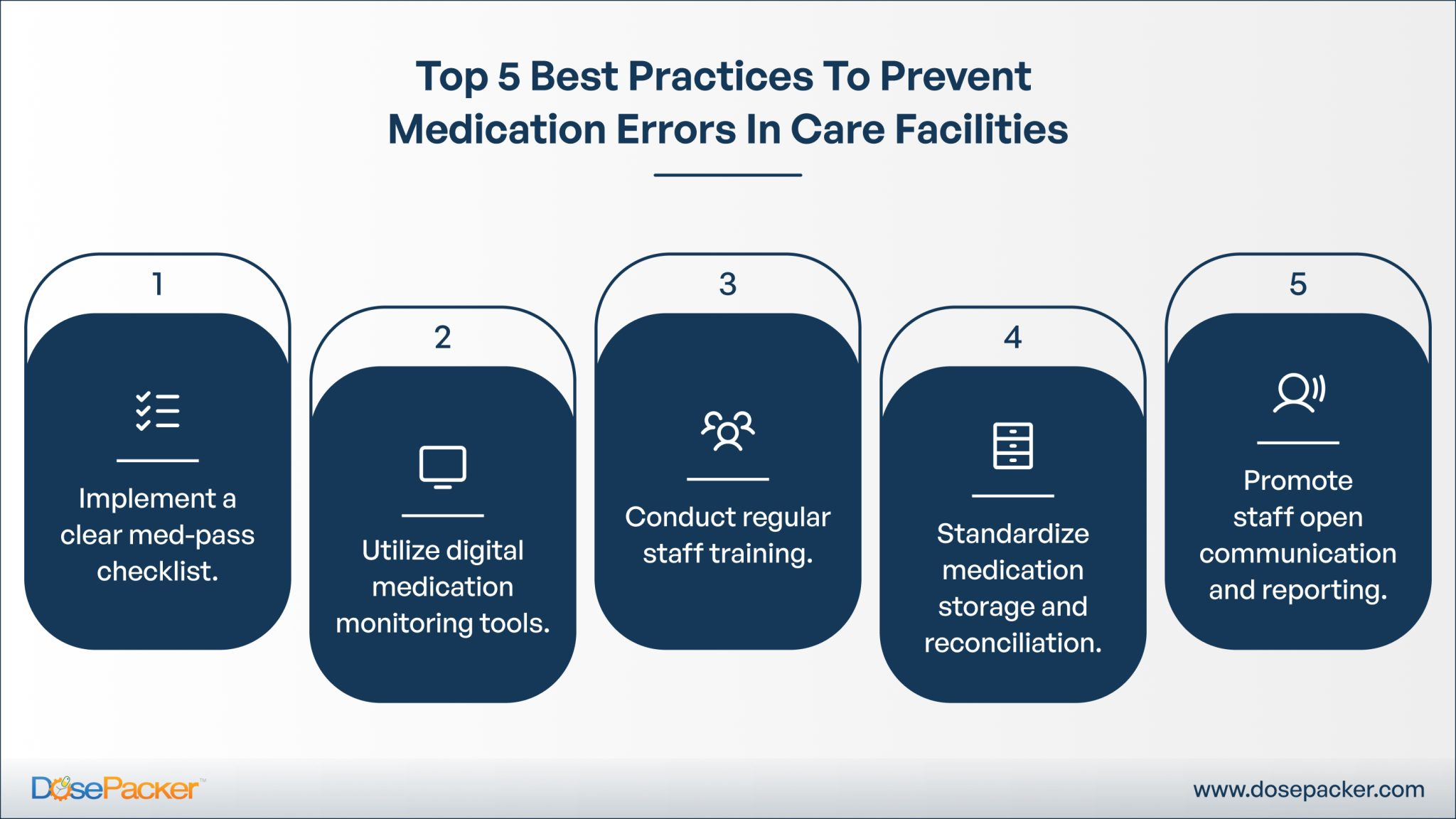
A reliable med-pass checklist ensures consistency and prevents steps from being skipped. Critical tasks include:
Fewer medication administration steps skipped lead to reduced chances of medication errors.
Manual documentation is slow and error-prone. Digital tools, like those featured in this blog, for medication monitoring help automate logging, capturing timestamps, and flagging missed or late doses, dramatically improving accuracy.
Keep caregivers updated with ongoing education on medication protocols, safety best practices, and new technology tools. Regular training refreshes critical skills and boosts confidence, helping staff avoid errors and respond quickly to challenges during med-passes.
Consistently organize and label medications to minimize confusion and expedite administration. Regularly review resident medication lists, especially after care transitions, to catch discrepancies early and ensure accurate treatment.
Encourage staff to report errors or near misses without fear of retribution. Open dialogue helps identify problem areas, supports continuous learning, and enhances safety protocols, resulting in fewer mistakes and improved resident care.
These best practices, combined with DosePacker’s innovative solutions, help care facilities deliver safer and more reliable medication management.
Preventing medication errors isn’t just about catching mistakes; it’s about building a system that makes them less likely to happen in the first place. DosePacker offers integrated solutions that address both the administration and adherence sides of medication management. By combining automation, accuracy, and accountability, DosePacker helps care teams reduce risks, lower costs, and deliver safer, more consistent care.
DosePacker delivers pre-sorted, dose- and time-specific medication packaging that is clearly labeled, removing any guesswork during medication passes. Caregivers scan each pack before administration, and the system instantly logs the dose in real time, eliminating manual documentation errors and ensuring full regulatory compliance.
It’s a centralized platform connecting every part of the medication workflow. CareCommunityOS consolidates medication data, provides real-time updates, and maintains comprehensive, audit-ready documentation. Staff can track medication administration, monitor adherence, and quickly identify missed or late doses, all from an intuitive dashboard that supports efficient care management.
DoseKart is a mobile medication cart designed to support caregivers during med-pass. Fully integrated with CareCommunityOS, it offers instant access to residents’ medications and barcode scanning capabilities. This empowers staff to confidently deliver the right medications at the right time, reducing errors and improving workflow efficiency.
It’s a smart reminder device that encourages resident independence by using visual and audio cues to prompt medication intake. It automatically sends real-time adherence updates back to CareCommunityOS, enabling caregivers to remotely monitor medication use and intervene promptly if doses are missed.
Together, these solutions create a medication management ecosystem that reduces errors, enhances communication, and promotes safer, more efficient care delivery.
Medication errors carry more than just clinical consequences; they also impact budgets, morale, and trust. However, facilities can turn things around by preventing medication errors in care facilities through the use of structured processes and smart technology.
Start here:
Be proactive, not reactive. Every avoided error saves money and dignity.
Ready to uncover and eliminate hidden costs?