
Pregnancy can change how you think about every medication you take. This guide explains how to review prescriptions, understand medication risks, manage doses, and build a safer medication routine throughout pregnancy.

Finding out you're pregnant can change the way you look at almost everything in your daily routine, including the medications sitting in your medicine cabinet.
A prescription you've taken for years may suddenly prompt a new question. An over-the-counter pain reliever you once used without hesitation may now require a conversation with your healthcare provider. Even vitamins and supplements deserve a second look.
That uncertainty is understandable. According to the CDC, about 9 in 10 women report taking some type of medicine during pregnancy, while about 7 in 10 report taking at least one prescription medicine. At the same time, fewer than 10% of medicines approved since 1980 have enough information to determine their safety during pregnancy.
That makes pregnancy medication safety less about memorizing a list of approved or prohibited medicines and more about making informed decisions with the right healthcare professionals.
This article explains what expecting mothers should know about pregnancy medication, how to approach medication decisions during pregnancy, and how better organization can support a safer daily routine.
Bring More Clarity to Your Medication Routine
Consider a woman named Sarah who has been taking medications for a chronic condition for several years.
When she discovers she is pregnant, her first instinct may be to stop taking it.
But pregnancy does not automatically mean that every existing medication should be discontinued. In some cases, leaving a health condition untreated can also create risks for both the mother and the developing baby. The CDC recommends speaking with healthcare providers before starting or stopping medications during pregnancy.
This is why there is no universal answer to searches for pregnancy-safe medications.
The right pregnancy medication can depend on the individual's condition, dose, timing, stage of pregnancy, other medications, and the benefits and risks of treatment.
The goal is not to avoid medication at all costs.
It is to make informed decisions about the medication prescribed for you.
When people search for medications safe in pregnancy, they often expect a straightforward list.
The reality is more nuanced.
Prescription medications may treat conditions that existed before pregnancy or develop during pregnancy.
A healthcare provider may determine that continuing a medication is appropriate, that the dose needs adjusting, or that another treatment should be considered.
The key step is having the medication reviewed rather than making changes independently.
Discuss pain relievers, allergy medications, cold products, antacids, and other over-the-counter medicines with a healthcare provider or pharmacist.
A product being available without a prescription does not automatically make it appropriate during pregnancy.
Prenatal vitamins are commonly part of pregnancy care, but supplements should still be included in a medication review.
Herbal products and dietary supplements can also contain active ingredients that may require consideration during pregnancy.
So when reviewing your pregnancy medication categories, think beyond prescription bottles. Your healthcare provider should know about everything you take.
Once pregnancy is confirmed, one of the most useful steps in pregnancy medication safety is creating a complete medication list.
Include:
Bring this list to your prenatal appointments and share it with the healthcare professionals involved in your care.
This is where medication management becomes important.
Instead of evaluating each medication individually, your healthcare team can review the full regimen and decide whether to continue, adjust, replace, or monitor medications.
For people taking several medications, medication therapy management can provide an additional structured review of the medication regimen and identify potential concerns that may otherwise be overlooked.
Knowing how to manage medications during pregnancy is about more than knowing which medication to take. Pregnancy medication safety also depends on following the prescribed instructions and maintaining a consistent routine.
It also means knowing when to take it, how to take it, what to do if you miss a dose, and how to keep the medication organized.
Understanding what a medication is treating gives you context for why consistency matters.
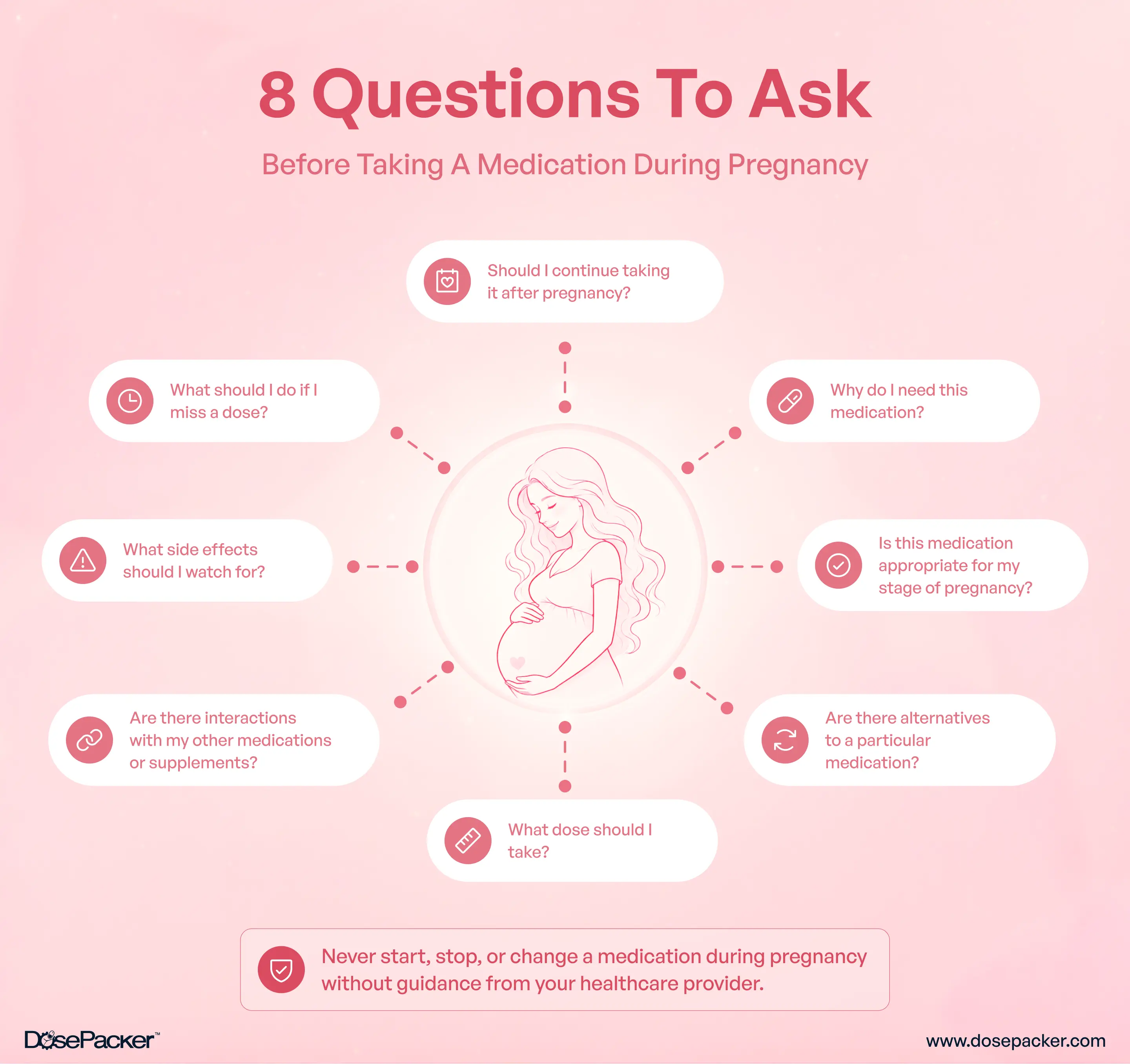
If your healthcare provider changes the medication, dose, or schedule, ask what changed and why.
Different medications can have very different instructions.
One may need to be taken at a particular time, another with food, while another may need to be separated from certain medications or supplements.
Do not assume that the same instructions apply to every medication.
Do not automatically take two doses to make up for a missed dose.
Ask your healthcare provider or pharmacist what the appropriate missed-dose instructions are for each medication in your routine.
Pregnancy can bring fatigue, nausea, changing schedules, appointments, and new responsibilities. When you add several medications to your routine, remembering every dose can become another daily challenge.
A consistent system can help reduce unnecessary confusion. Simple medication safety tips, such as keeping an updated medication list and following a consistent schedule, can also make daily medication management easier.
Medication safety does not stop once a healthcare provider has established the treatment plan.
The next challenge is following that plan consistently.
Imagine Sarah taking several medications at different times of day. Her prescriptions are appropriate, and her instructions are clear, but every morning and evening she still needs to identify the correct medication, check the label, remember whether she has already taken it, and keep everything organized.
That is where a right medication management system can add practical support.
DosePacker does not determine which medications are appropriate during pregnancy. Instead, once a pharmacy and healthcare team have established the prescribed regimen, DosePacker's multi-dose compliance packaging can help organize the medication schedule into clearly identified doses.
DosePacker's medication management solutions are designed around a simple principle: make the prescribed medication routine easier to follow and verify.
Its compliance packaging can organize medications by date and administration time, so patients or caregivers don't have to sort multiple medications manually.
For example, DosePacker's compliance packaging can provide:
The benefits of compliance packaging can therefore extend beyond convenience. Organized doses can support medication identification, reduce manual sorting, and clarify the connection between the prescribed schedule and the medication being administered.
Physical organization is only one part of medication management.
DosePacker's MyDoses app adds a digital layer by connecting medication packaging with documentation. Depending on the workflow, doses can be scanned and time-stamped to create a digital record of administration.
This can be particularly useful when caregivers or care teams need greater visibility into whether a dose was administered.
It is also different from basic medication reminder solutions.
A reminder may tell someone that it is time to take medication. A connected packaging and documentation workflow can help identify the scheduled dose and record what happened afterward.
For DosePacker, the objective is to make medication management more organized and verifiable, not to make clinical decisions about which medications are appropriate.
Discovering that you took medication before realizing you were pregnant can be alarming.
It does not automatically mean that harm has occurred.
The appropriate response depends on the specific medication, dose, timing, and individual circumstances, which is why pregnancy medication safety decisions should be based on individualized medical guidance.
Instead of trying to determine the risk of a pregnancy medication exposure from an online list, gather the medication name, dose, and timing, then speak with your healthcare provider or pharmacist.
When Sarah first discovered she was pregnant, she looked at the medications on her counter and saw potential risks.
After speaking with her healthcare team, she saw something different: a treatment plan she could understand, monitor, and manage.
That shift- from uncertainty to informed decision-making is at the heart of pregnancy medication safety. And when managing that plan becomes difficult, the right tools can help make the daily medication routine more organized and easier to follow.
DosePacker helps turn an established medication plan into a clearer, more structured routine, giving patients and caregivers greater visibility into every dose.
Medical disclaimer: This content is for educational purposes only and is not a substitute for medical advice. Expecting mothers should consult their physician, pharmacist, or other qualified healthcare professional before starting, stopping, or changing any medication, supplement, or treatment.
Looking for a Simpler Way to Organize Medications?
See how DosePacker’s solutions can help organize prescribed medications into a clear, easy-to-follow daily routine.
