Take a closer look at the differences between open and closed formularies, weigh the trade-offs of each, and learn a practical approach to selecting the right formulary model for your pharmacy.

Every pharmacy, health plan, and health system has to answer a version of the same question: how much prescribing flexibility should the formulary allow, and how much should it restrict? The answer isn't just a policy detail; it influences medication access, pharmacy costs, operational efficiency, and ultimately, patient care. According to a 2025 report, 62% of employers and health plans rely on a national or preferred formulary with exclusions, while only 11% use an open formulary without exclusions. As organizations increasingly adopt more structured approaches to medication selection, understanding the differences between open vs. closed formulary models has become essential for balancing prescribing flexibility with cost control.
That trade-off sits at the center of the open vs closed formulary decision. Long-term care pharmacies feel it especially acutely, since they manage high prescription volumes, frequent transitions of care, and residents with complex, overlapping conditions. Choosing the right structure doesn't just influence pharmacy spending; it affects how quickly residents receive their medications, how consistently therapy is managed across facilities, and how efficiently pharmacy teams operate.
Whether you're evaluating an open and closed formulary for the first time or reassessing your current approach, understanding the strengths and limitations of each model is essential to building an effective pharmacy formulary management strategy.
Want to see how a connected system supports either formulary model?
An open formulary is a medication list that provides broad prescribing access, allowing physicians to prescribe most or all FDA-approved medications without being limited to a tightly controlled list of preferred products. Prior authorization requirements are generally minimal, giving providers greater flexibility to make treatment decisions based on individual clinical needs.
Rather than steering clinicians toward specific medications, an open formulary prioritizes physician judgment and patient-specific care. This approach is commonly used in healthcare environments where patient populations are highly diverse, specialized therapies are frequently required, or continuity of existing medication regimens is a priority.
In practice, medications typically do not require committee pre-approval before they can be prescribed and dispensed. While pharmacies continue to monitor utilization, safety, and costs, prescribers retain greater freedom to select therapies based on clinical expertise. This flexibility is particularly valuable when residents transition from hospitals or other care settings with established medication regimens, reducing unnecessary interruptions in therapy.
Although organizations may still encourage the use of preferred medications through clinical guidelines or payer incentives, non-preferred therapies are generally easier to access than they would be under a more restrictive formulary.
One of the greatest advantages of an open formulary is its flexibility. Physicians can tailor treatment plans to individual residents, making it easier to manage complex medical histories, multiple chronic conditions, medication allergies, or therapies that haven't responded to standard treatment options.
Open formularies also support continuity of care. Residents moving between hospitals, rehabilitation centers, and long-term care facilities often remain on their existing medications rather than being switched to formulary-preferred alternatives solely due to administrative requirements.
From an operational standpoint, fewer prior authorizations and exception requests reduce administrative work for pharmacists and prescribers, allowing more time to focus on resident care instead of paperwork.
The same flexibility that benefits patients can introduce operational challenges. Broader medication access often leads to less predictable pharmacy spending, particularly when prescribers opt for newer or higher-cost therapies rather than preferred alternatives.
Maintaining a wider inventory also increases purchasing complexity and may require pharmacies to stock more medications, making inventory management and medication packaging less efficient. In addition, greater prescribing flexibility can lead to greater variation among providers, increase the risk of therapeutic duplication, and potentially contribute to medication errors unless utilization is carefully monitored.
These challenges don't necessarily make an open formulary less effective, but they do require stronger oversight and data-driven pharmacy formulary management to balance clinical freedom with operational efficiency.
Understanding what a closed formulary is begins with one key principle: standardization. A closed formulary restricts prescribing to a defined, pre-approved list of medications selected based on clinical evidence, safety, therapeutic value, and cost-effectiveness. Medications outside that list generally require prior authorization, a formal exception, or therapeutic interchange before they can be dispensed.
The approved medication list is typically developed and maintained by a multidisciplinary Pharmacy and Therapeutics (P&T) committee that regularly reviews new clinical evidence, medication trends, medication shortages, and reimbursement considerations. Rather than limiting care, the goal is to encourage consistent, evidence-based prescribing while improving operational efficiency and controlling pharmacy costs.
Within each therapeutic class, a limited number of preferred medications are selected based on clinical outcomes and overall value. Physicians are expected to prescribe from these approved options whenever appropriate, while requests for non-formulary medications follow an established review process.
This structured approach helps healthcare organizations standardize prescribing practices across multiple facilities while simplifying inventory management, improving purchasing efficiency, and promoting more consistent medication use.
A closed formulary promotes greater consistency across prescribing practices by encouraging clinicians to use medications that have already been evaluated for safety, effectiveness, and value. Standardization not only supports evidence-based care but also simplifies inventory planning, medication packaging, and purchasing decisions.
Because pharmacies stock fewer products, they can improve inventory control, reduce waste, and negotiate stronger purchasing agreements with manufacturers and suppliers. The result is better cost predictability and improved visibility into medication utilization trends, making it easier to monitor prescribing patterns across facilities.
For organizations operating multiple care communities or managing complex payer contracts, this level of consistency can significantly improve both clinical and operational performance.
While a closed formulary offers greater control, it also introduces additional administrative and clinical considerations. Prior authorization requirements and exception reviews can delay therapy if workflows aren't efficient, particularly when residents require medications outside the approved list.
In some situations, prescribers may need to transition residents to formulary-preferred alternatives upon admission to a long-term care facility. Although therapeutic interchanges are guided by clinical evidence, they require careful communication and monitoring to maintain continuity of care.
Managing a closed formulary also demands ongoing oversight. Pharmacy and Therapeutics (P&T) committees must continually evaluate new medications, monitor utilization trends, respond to drug shortages, and review updated clinical guidelines to ensure the formulary remains both clinically relevant and financially sustainable.
Neither model is inherently better. An open formulary gives prescribers greater flexibility to tailor treatments to individual residents and helps maintain continuity of care during transitions. A closed formulary, on the other hand, supports standardized prescribing, improves inventory management, and provides greater control over pharmacy costs.
The right approach depends on an organization's clinical priorities, resident population, payer requirements, and operational goals. For many long-term care pharmacies, success is about finding the right balance.
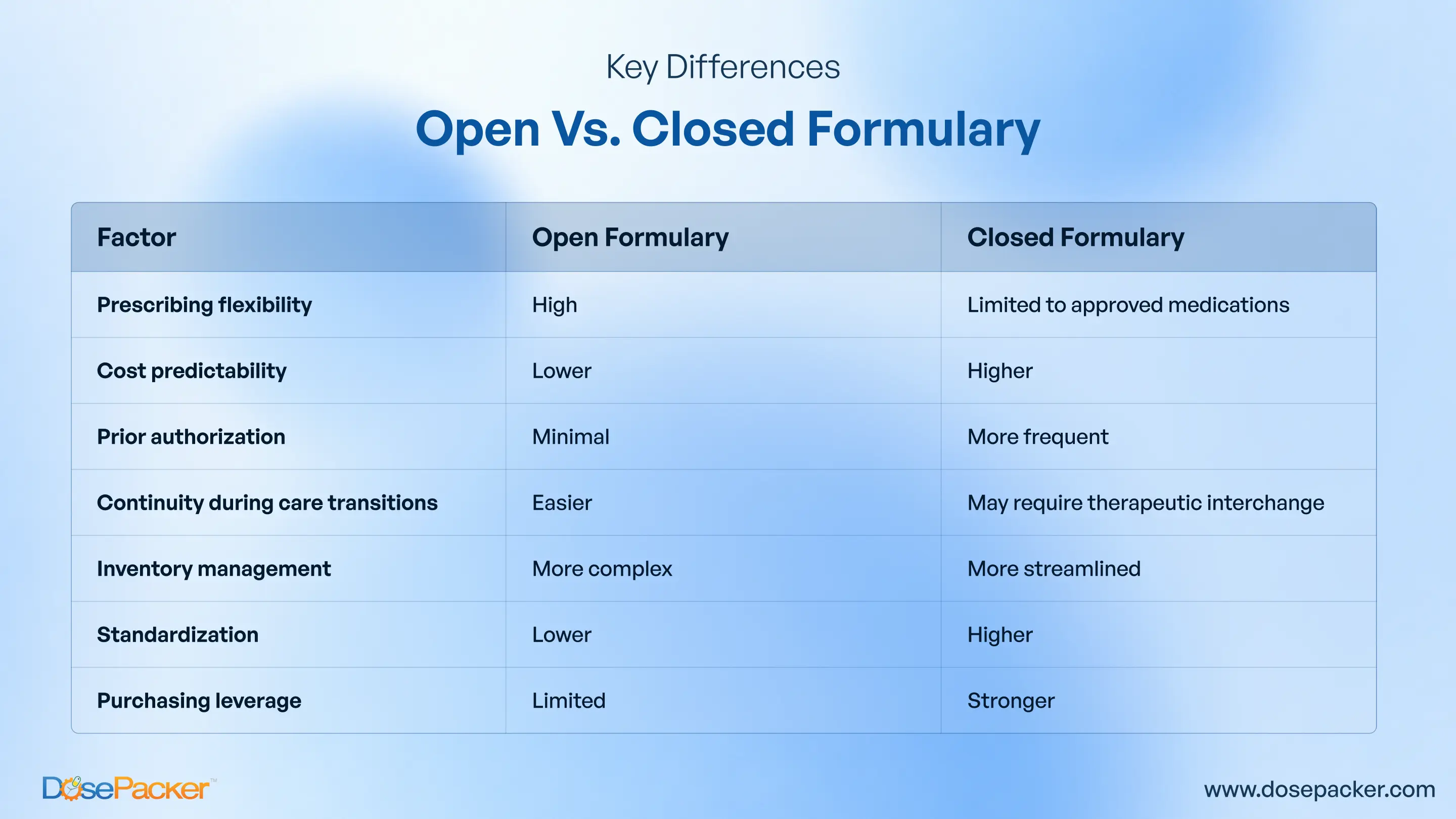
For many healthcare organizations, the answer isn't choosing one model over the other; it's combining both.
A hybrid formulary typically standardizes medications in high-volume or high-cost therapeutic classes while allowing greater flexibility where clinical variability is greater or maintaining an existing therapy is especially important. This approach helps organizations control costs without unnecessarily limiting physician decision-making or disrupting resident care.
Rather than viewing an open and closed formulary as opposing models, many long-term care pharmacies use them together to achieve the right balance between consistency and flexibility.
Choosing the right formulary model is only the first step. Long-term success depends on how effectively that formulary is managed, monitored, and integrated into everyday pharmacy operations.
Resident needs should drive formulary decisions. Long-term care residents often manage multiple chronic conditions, receive medications from multiple specialists, and experience frequent transitions between healthcare settings. In these cases, preserving continuity of therapy can be just as important as controlling medication costs.
Organizations serving more standardized patient populations may benefit from a more structured formulary, while those managing clinically complex residents often require greater flexibility within specific therapeutic categories.
Every formulary should support both quality care and operational efficiency. Standardizing medication selection can improve inventory management, simplify purchasing, reduce therapeutic duplication, and strengthen contract negotiations. At the same time, pharmacy leaders must ensure cost-saving initiatives never compromise clinical outcomes or delay appropriate treatment.
Finding the right balance requires ongoing review rather than treating the formulary as a static document.
As formularies become more sophisticated, manual processes become increasingly difficult to sustain. Modern pharmacy formulary management platforms provide real-time visibility into medication utilization, prescribing trends, inventory, therapeutic interchanges, and exception requests.
This centralized approach enables pharmacy teams to make faster, evidence-based decisions, identify opportunities for medication optimization, and maintain consistency across multiple facilities.
Effective pharmacy formulary management doesn't end with selecting the right medications; it requires those decisions to be reflected consistently across prescribing, dispensing, and packaging. Without connected systems, formulary updates, medication changes, and therapy adjustments can create unnecessary manual work and increase the risk of inconsistencies.
DosePacker's formulary management solutions help long-term care pharmacies execute formulary decisions consistently across prescribing, dispensing, packaging, and medication administration.
Through an integrated medication management ecosystem, solutions such as CareCommunityOS, DosePack compliance packaging, and DoseKart support prescription processing, medication packaging, refill management, and coordination across care teams. This connected approach helps pharmacies improve operational efficiency, maintain greater consistency across facilities, and ensure formulary decisions translate seamlessly into everyday resident care.
The choice between an open and closed formulary isn't about determining which model is universally better. It's about selecting the approach that best aligns with your resident population, operational complexity, and clinical goals.
Open formularies provide greater prescribing flexibility and help preserve continuity of care. Closed formularies improve standardization, inventory control, and cost predictability. For many long-term care pharmacies, a hybrid approach offers the best of both by combining standardized medication management with the flexibility to address individual resident needs.
As medication therapies, regulatory requirements, and reimbursement models continue to evolve, effective pharmacy formulary management must become an ongoing clinical and operational strategy rather than an annual administrative task. With the right balance of evidence-based decision-making, continuous oversight, and integrated technology, pharmacies can build formularies that improve efficiency while supporting safer, higher-quality resident care.
Discover how DosePacker helps long-term care pharmacies streamline formulary management and ensure consistent medication workflows across every stage of care.