Step inside a skilled nursing facility and discover what a typical day looks like for a nurse and the responsibilities that keep residents safe.

Skilled nursing facilities are among the most clinically demanding settings in long-term care, and the people running them carry that weight every single shift.
According to AHCA/NCAL, approximately 1.38 million residents receive care in U.S. nursing homes every day, many of whom require ongoing medication management, chronic disease monitoring, rehabilitation, and round-the-clock clinical supervision.
For skilled nurses, every shift means balancing dozens of medication schedules, resident assessments, physician orders, and documentation requirements while ensuring each resident receives safe, timely care.
Understanding what daily life looks like explains a lot about how skilled nursing facilities are run, and why the tools nurses use for medication management end up mattering almost as much as their clinical training. It's part of why DosePacker's medication management solutions have become a working part of so many daily routines, not an add-on bolted onto existing processes, but something built into how the shift runs.
See How DosePacker Supports Skilled Nursing Teams
A skilled nursing facility is a licensed setting where residents get medically supervised care that goes beyond what assisted living or home-based support can offer. Skilled nursing care typically includes round-the-clock nursing supervision, wound management, IV therapy, rehabilitation services, and medication administration for residents who often juggle several chronic conditions at once.
The line between this and assisted living comes down to staffing and supervision. A skilled nursing facility runs on licensed nurses who carry clinical responsibility for each resident’s condition, not just their comfort or day-to-day support. That distinction shapes nearly everything about how a nurse’s shift unfolds.
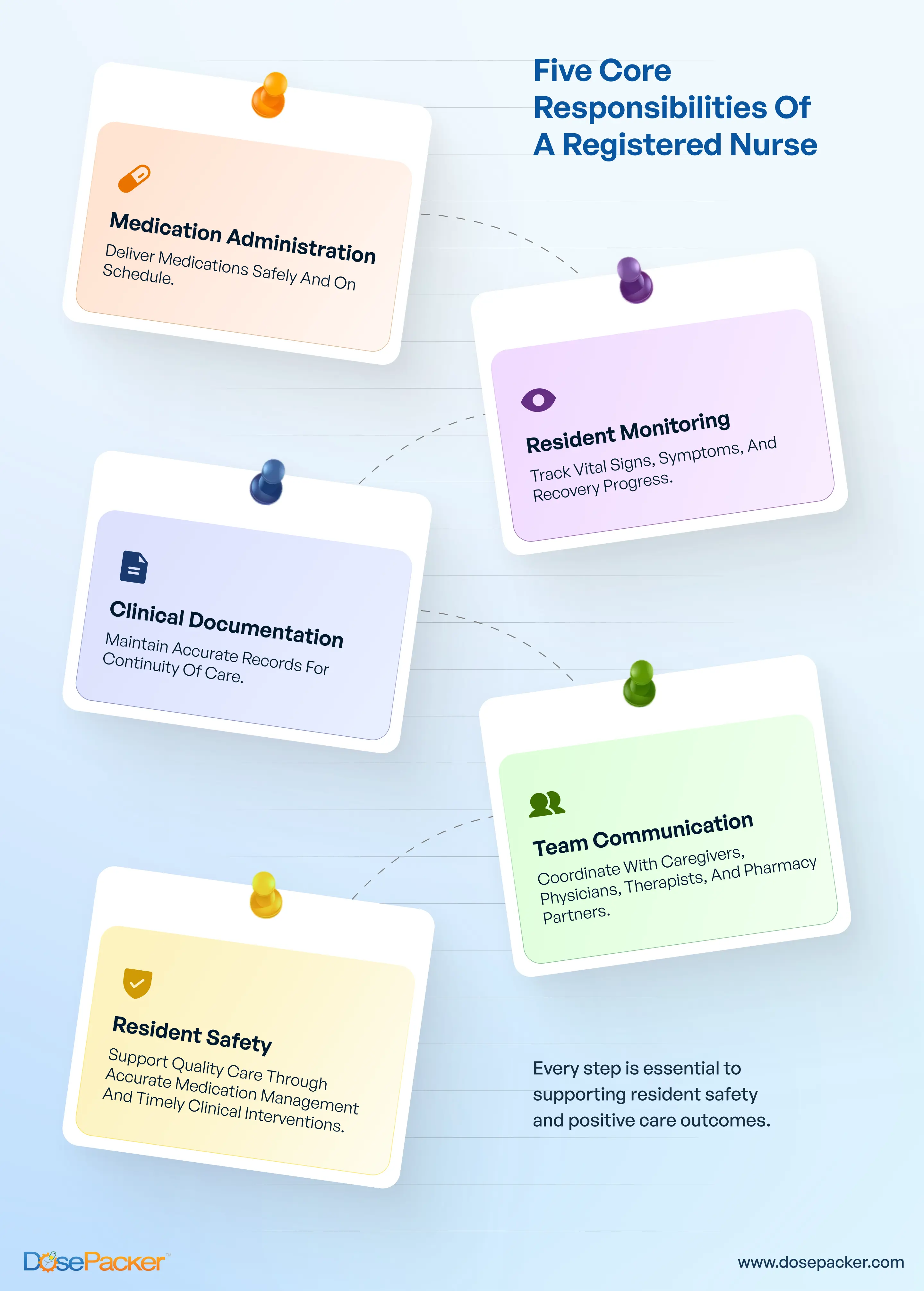
Talk to any nurse working in long-term care, and they’ll tell you no two shifts are alike. Residents’ needs shift by the hour, and a single fall or fever can rearrange an entire floor’s plan for the day. Even so, most shifts follow a rhythm built around a handful of core responsibilities.
The day starts with a report from the outgoing shift, then moves quickly into morning rounds. Nurses check vitals, note any overnight changes, and begin the first med-pass before breakfast trays have even cleared.
Every dose must follow the established medication administration rights, confirming the right resident, medication, dose, route, and time, while documenting each administration accurately.
This is where organized medication management systems can make a meaningful difference. Resident-specific compliance packaging and DoseKart work together to streamline medication administration, helping nurses quickly identify scheduled medications while reducing the time spent sorting, verifying, and documenting doses during busy medication passes.
Every medication given, every symptom noted, every change in a resident's status must be documented as it occurs. This is the record that physicians, pharmacists, and state surveyors rely on later.
Nurses are expected to chart between rounds, often while fielding call lights, answering family questions, and keeping an eye on residents who can't always communicate what's wrong. Skip a note here or there, and the gap can mean a missed follow-up or a flagged chart during the next survey.
Medication is only part of the job. Wound care, catheter management, IV therapy, and monitoring residents recovering from surgery or illness are all part of a nurse's daily responsibilities. Many residents are also working with physical, occupational, or speech therapists throughout the day, and nurses stay in close contact with those teams to track progress and flag anything that's not improving.
No nurse works alone in this setting. Physicians, pharmacists, therapists, dietary staff, and family members all rely on the nurse to pass along accurate information at the right time. A change in a resident's diet, mobility, or medication has to travel across the whole team, sometimes more than once in a single shift, before it actually sticks.
Residents often transition between hospitals, specialists, and skilled nursing facilities. Medication changes made during these transitions need to be communicated clearly between physicians, pharmacies, and nursing staff to help ensure medications are administered correctly at the next scheduled med-pass.
Day-to-day care gets most of the attention, but skilled nursing facility services cover more ground than what happens at the bedside. Depending on the facility, this can include:
Each of these adds another layer to a nurse's workload, especially when residents move in and out of higher-acuity needs without much warning.
Even seasoned nurses run into structural pressures that no amount of training fully fixes. Staffing shortages remain one of the biggest challenges facing skilled nursing facilities, often leaving nurses responsible for more residents than ideal ratios would call for.
Rising resident acuity makes this worse. As more residents arrive with complicated, multi-condition histories, medication regimens get harder to manage by hand. Layer documentation demands on top of that, and it's not surprising that many nurses say a noticeable chunk of their shift goes to paperwork instead of patients.
This isn't just a morale issue. Time pressure and interruptions during med-passes are well-documented contributors to medication errors in skilled nursing and assisted living settings, which is exactly why error-reduction tools are no longer optional in many communities.
Families weighing care options often compare skilled nursing with other forms of long-term care. Understanding the differences between home health and skilled nursing can help when deciding whether recovery at home is appropriate, while comparing assisted living and skilled nursing facilities highlights how the level of medical supervision changes as care needs become more complex.
One pattern holds across both comparisons: the more clinically intensive the setting, the more a nurse's day gets shaped by medication management, charting, and the clock.
Technology isn't a substitute for clinical judgment, but it can take real friction out of a nurse's day, particularly around medication administration, which is consistently one of the most time-consuming and error-prone parts of the shift.
DosePacker's skilled nursing solutions are designed to support the entire medication management workflow. CareCommunityOS serves as the central platform, providing care teams with real-time visibility into medication schedules, resident information, and administration records, while improving communication between the pharmacy and the facility.
Working alongside CareCommunityOS, DoseKart, DosePacker's motorized medication cart supports medication administration with scan-to-confirm verification and digital tracking, helping nurses move through medication passes more efficiently while reducing the risk of administering a medication to the wrong resident.
DosePacker Storage provides nursing staff with an organized and secure way to manage resident-specific compliance packs, making medications easier to locate and access during busy shifts.
Together, these solutions create a more connected medication management process that reduces manual steps, improves accuracy, and gives skilled nursing teams more time to focus on resident care.
A skilled nurse’s day is rarely predictable, but it’s consistently demanding. Between medications, documentation, hands-on care, and constant coordination, nurses are managing more moving pieces than most outsiders would guess, often with thinner staffing and higher-acuity residents working against them.
Facilities that invest in tools built to ease that administrative load and tighten medication accuracy aren’t just checking a compliance box. They’re giving their nursing staff more room to do the work they actually trained for.
Curious How DosePacker Could Fit Into Your Facility’s Routine?